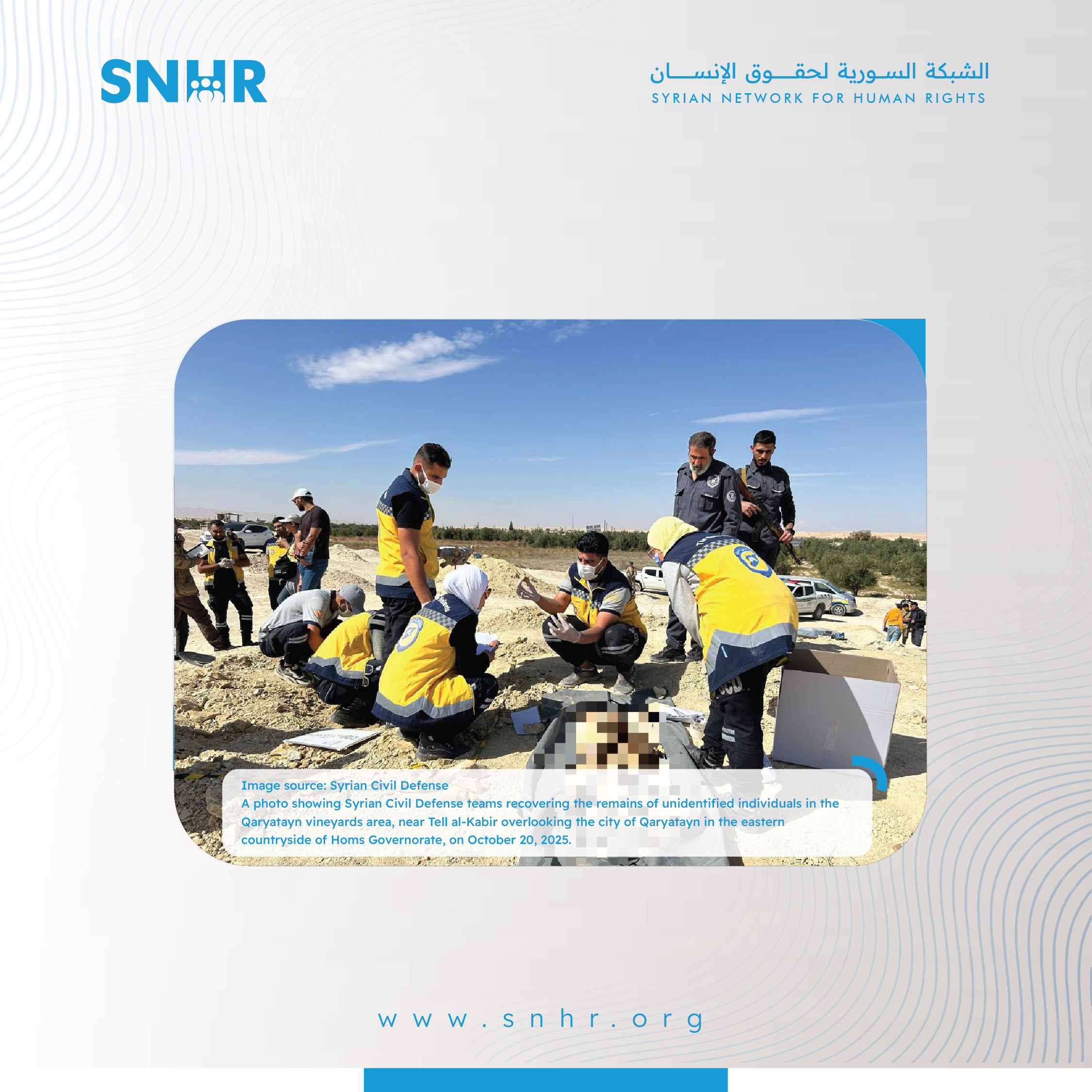

On Monday, October 20, 2025, local residents found the remains of at least eight civilians, including three children and four women, who have not yet been identified. The remains were found in the Al-Qaryatayn vineyard area, near Tell al-Kabir, overlooking the city of Al-Qaryatayn in the eastern countryside of Homs Governorate. This happened while a farmer was working on his agricultural land, located near a former military site of the Bashar al-Assad regime forces.
Syrian Civil Defense teams responded to the report and recovered the remains, in the presence of representatives from the National Commission for Missing Persons, the Public Prosecution, the Criminal Security Department, and the Forensic Medicine Identification Center. No personal belongings (such as clothing) were found with the remains. It should be noted that the area is under Syrian government control. The Syrian Network for Human Rights notes that the issue of mass graves in Syria is one of the most complex human rights issues, as tens of thousands of families still do not know the fate of their relatives who were forcibly disappeared during the years of armed conflict.
We are continuing our investigations, including reviewing and collecting more evidence and information. Therefore, we hope that anyone with information or details related to this incident will provide it to us via our official email: [email protected].
Legal Conclusions:
- The presence of the remains of individuals believed to be civilians killed during the armed conflict, particularly with signs of torture or gunshot wounds, suggests the possibility of extrajudicial killings or mass executions, which constitute crimes against humanity.
- Any tampering with the site or unlawful burial of victims constitutes the destruction of forensic evidence related to serious international crimes, threatening the right to truth and obstructing access to justice and redress.
The Syrian Network for Human Rights’ recommendations:
- Immediately freeze the site as an international crime scene, and prevent any tampering with forensic evidence by any party until the arrival of specialized forensic teams and international criminal investigations.
- Involve Syrian civil society, families of missing persons, and victims in investigation and documentation mechanisms, and provide psychological and legal support to families immediately upon identification of victims.
- Launch a unified national and international database for missing persons, with the aim of matching DNA with victims and helping thousands of families learn the fate of their relatives, as a central step in the transitional justice process.