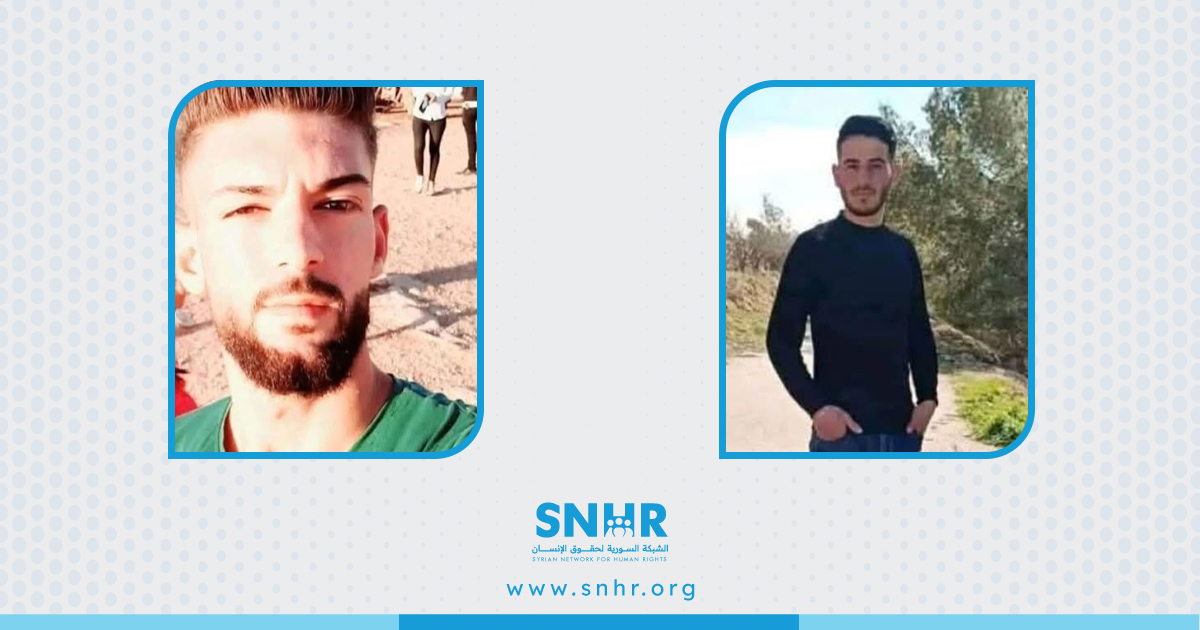

On Saturday, November 22, 2025, local residents found the bodies of Wissam Daher al-Ali, 23, and Muhammad Saleh al-Ali, 24, both from the village of Abu Hakfa in the eastern Homs countryside, on 60th Street in Homs. Both bodies bore gunshot wounds. The area is under the control of the Syrian government.
According to information obtained by the Syrian Network for Human Rights from reliable local sources, contact was lost with Wissam and Muhammad while they were in the al-Zahraa neighborhood of Homs. They were found the same day on 60th Street in eastern Homs. Both bodies bore gunshot wounds and were transferred to al-Waer Hospital before being handed over to their families.
We are continuing our investigation, including reviewing and gathering further evidence and information. Therefore, we urge anyone with information or details regarding this incident to provide them to us via our official email address.
Legal Conclusions:
- The discovery of the bodies of Wissam and Muhammad al-Ali, bearing gunshot wounds, without any record of an armed clash, arrest warrant, or any judicial proceedings, suggests the possibility of extrajudicial killings and summary executions. This constitutes a flagrant violation of Article 6 of the International Covenant on Civil and Political Rights, which guarantees the right to life.
- Given that the area is under the control of the Syrian government, the occurrence of this crime within its jurisdiction without preventative measures represents a failure to fulfill the state’s duty to protect the right to life and personal security. This contravenes the principle of the “duty to protect,” which obligates authorities to prevent violations in areas under their control.
The Syrian Network for Human Rights recommends:
- Launch an urgent, impartial, and transparent criminal investigation to identify those responsible for the killing of Muwaffaq Haroun, with the participation of independent forensic experts, and publish the investigation’s findings for public review.
- The Syrian government must fulfill its security responsibilities by activating monitoring and response mechanisms to protect civilians in rural areas and intensifying patrols in areas with active civilian life.
- Provide immediate compensation to the victims’ families, including material and moral support, as well as psychological and social support, recognizing them as victims of extrajudicial killings.
- Establish a database of unsolved killings and enforced disappearances to identify patterns and facilitate future legal accountability within the framework of due process.