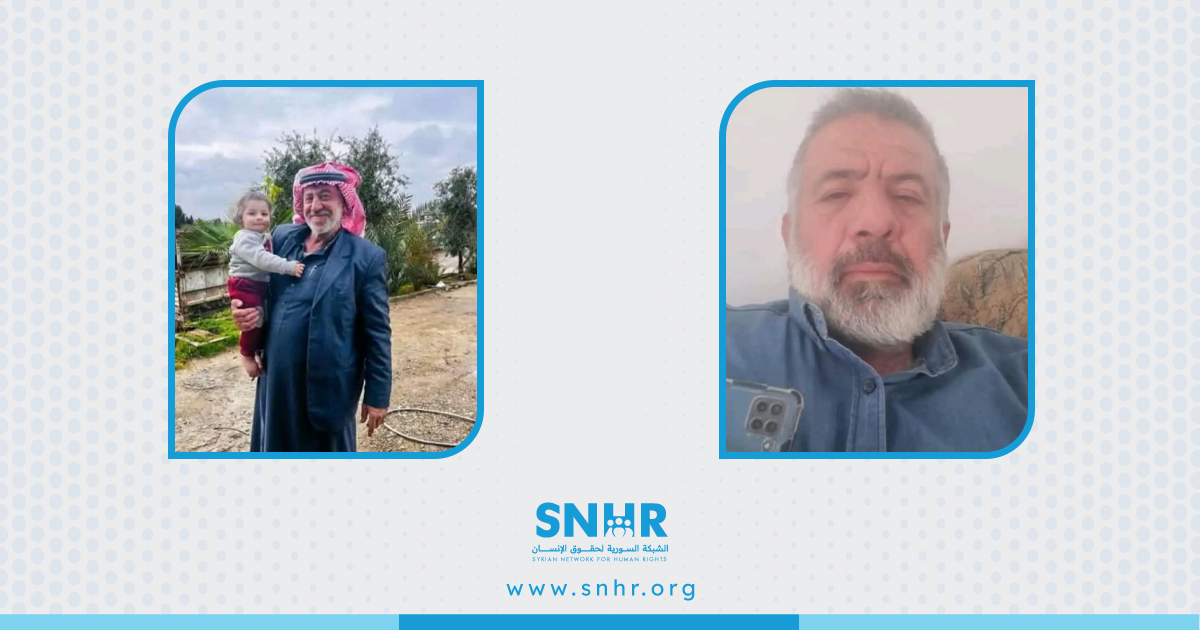

On Thursday, August 7, 2025, Muhammad Qasim al-Ahmad and Khalil Mukhlif al-Nasser, both from the city of al-Sukhnah in the eastern countryside of Homs Governorate, were killed while attempting to dismantle a landmine in the al-Sukhnah desert. The mine exploded during the dismantling process, killing them instantly. It is worth noting that Muhammad and Khalil were members of the 42nd Division of the Syrian Ministry of Defense, and the area is under the control of the transitional government.
According to preliminary information obtained by the Syrian Network for Human Rights from reliable local sources, the mine was leftover from the armed conflict in the area, and it is unknown who planted it. Demining teams were working at the site as part of efforts to clear residential areas, roads, and agricultural lands, with the aim of ensuring the safety of civilians and reducing the risks posed by unexploded ordnance. The network notes that remnants of war continue to pose a direct threat to the lives of civilians and mine clearance workers, with similar incidents being recorded repeatedly.
Legal Conclusions:
- The mine explosion that killed Mohammed Al-Ahmad and Khalil Al-Nasser while they were clearing and removing mines to secure the area is an example of how the effects of conflict continue to threaten civilian lives.
- The continued presence of landmines in populated areas or close to civilian activity, without removing them or warning the population of their presence, constitutes a violation of positive protection obligations under international humanitarian law, particularly Article 10 of the Amended Protocol to the Convention on Conventional Weapons (CCW) on Mines, Booby-Traps, and Improvised Explosive Devices.
- The failure of controlling parties to provide mine maps or place clear warning signs exposes civilians to death or injury and constitutes a violation of the principle of the duty to warn and inform enshrined in international humanitarian law.
- The inability to identify who laid the mine raises the issue of impunity, which requires an independent investigation and underscores the need for comprehensive documentation of remnants of war and contamination sites to avoid recurring incidents.
- The continued presence of mines in civilian areas constitutes a threat to the right to life and bodily integrity.
The Syrian Network for Human Rights’ recommendations:
- Open an urgent investigation into the incident to determine which parties to the conflict planted mines in the area and hold the responsible party legally responsible for negligence or deliberate action.
- Accelerate landmine clearance operations, especially in agricultural and pastoral areas close to population centers, in cooperation with international organizations such as UNMAS, the Syrian Arab Red Crescent, and the Syrian Civil Defense.
- Prepare comprehensive and updated maps of mines and remnants of war and disseminate them locally, with clear warning signs in all suspected areas, particularly those under the effective control of forces on the ground.
- Implement comprehensive local awareness campaigns targeting residents of rural areas and camps on the dangers of mines and how to identify and avoid them, in cooperation with civil society organizations.
- Provide direct support to the families of victims through urgent financial compensation, psychosocial support, and inclusion in programs to assist victims of remnants of war.