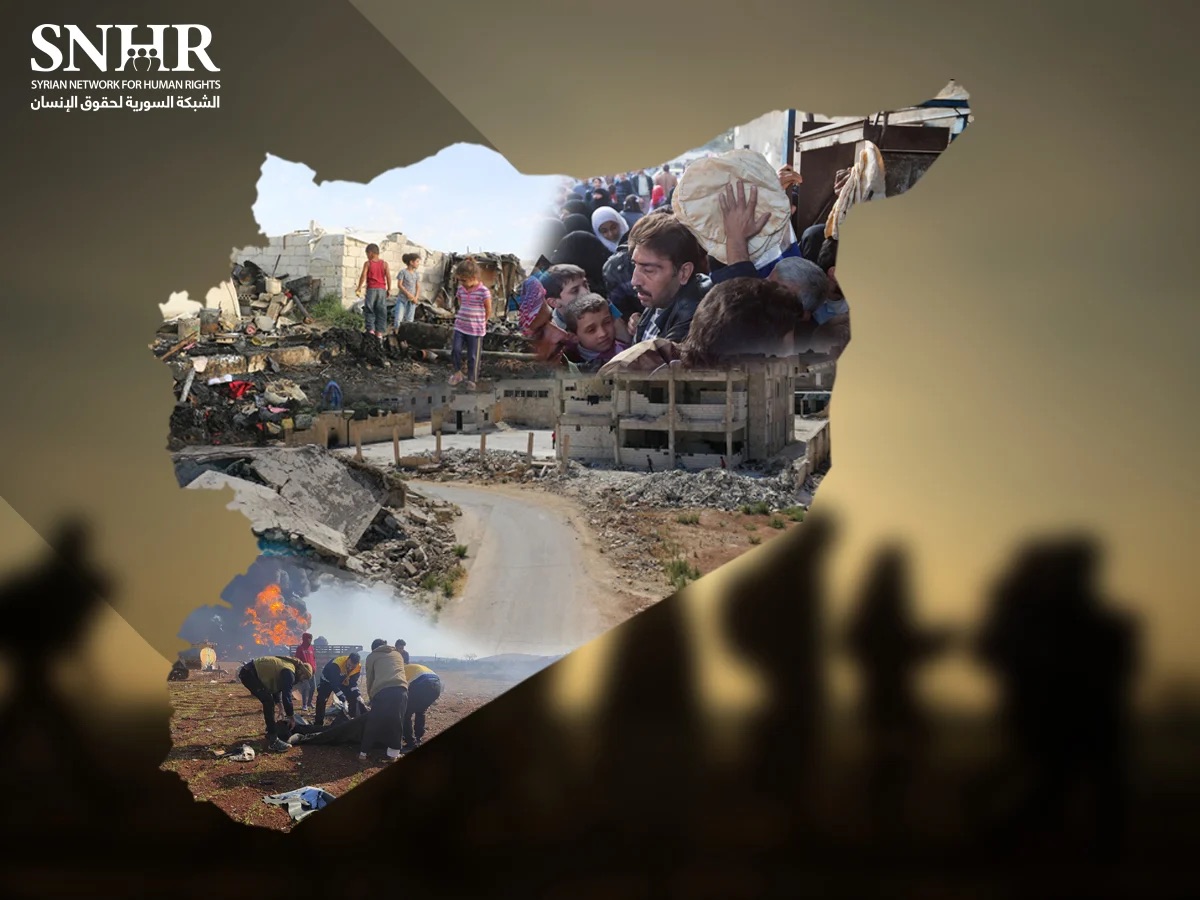

On Monday, June 9, 2025, the Syrian Network for Human Rights documented the arbitrary detention by Israeli Occupation forces of the civilian Ahmad al-Nada and two of his sons, all residents of the village of Manshiyat Suwaisa in the southern countryside of Quneitra Governorate. The detention occurred during a ground incursion into the village, backed by military vehicles.
According to information obtained by the Syrian Network for Human Rights from reliable local sources, Israeli occupation forces detained them while they were in their home in the village of Manshiyat Suwaisa and forcibly transferred them to the Tal Ahmar area, south of the village of Kudna in the Quneitra countryside, which is under Israeli control.
SNHR documented the release of the civilians several hours later, but without any clear legal procedures, which makes their detention arbitrary, prohibited under international human rights law.
Legal Conclusions:
- The detention of a civilian and his children without a judicial warrant, a clear security necessity, or charges, and without respect for fair trial guarantees, constitutes arbitrary detention under Article 9 of the International Covenant on Civil and Political Rights, which prohibits deprivation of liberty without legal basis.
- According to Additional Protocol I to the Geneva Conventions (Article 75), all detained persons must be treated humanely, with respect for their legal rights, which was not respected in this incident, neither in terms of the legal basis for detention, nor in terms of its duration or place.
- The Israeli military incursion and detention operations inside Syrian territory constitute a flagrant violation of Article 2(4) of the United Nations Charter, which prohibits the use of force against the territorial integrity of any Member State and constitutes an act of aggression that violates the rules of public international law.
- Repeated incursions and occupation of military barracks inside Syria, as well as security operations and detentions, are practices that perpetuate an unrecognized occupation and may pave the way for demographic change or the imposition of a de facto military authority, threatening broader grave violations.
The Syrian Network for Human Rights strongly condemns the Israeli ground incursion, raids, and arbitrary detention of civilians, and stresses that these practices constitute a flagrant violation of international humanitarian law, including the Fourth Geneva Convention of 1949 and the International Covenant on Civil and Political Rights. In this context, the Syrian Network for Human Rights recommends the following:
- Clear international condemnation of the illegal detention by the Israeli occupation forces, considering it a violation of the Geneva Conventions and the UN Charter, requiring legal accountability.
- Calling on the UN Security Council and Human Rights Council to investigate the incident, through mechanisms such as the International Independent Mechanism (IIIM), and document it within the pattern of Israeli violations in southern Syria.
- Demanding that Israel disclose details of the detention process, provide public legal justifications, and compensate the detained civilians for the violations they suffered, including material and moral harm.
- Demanding that Israel disclose details of the detention process, provide public legal justifications, and compensate the detained civilians for the violations they suffered, including material and moral harm.
- Deploying international monitoring forces or expanding the scope of work of the United Nations Disengagement Observer Force (UNDOF) to include monitoring cases of detention and violations against civilians in the Syrian border areas.
- Activate international criminal accountability tools, especially the International Criminal Court (ICC), to consider classifying these practices as war crimes related to unlawful detention in occupied or disputed territories.
- Improving civilian protection in conflict zones by establishing local early warning networks and documenting unauthorized foreign troop movements, in cooperation with local civil society organizations and human rights activists.